

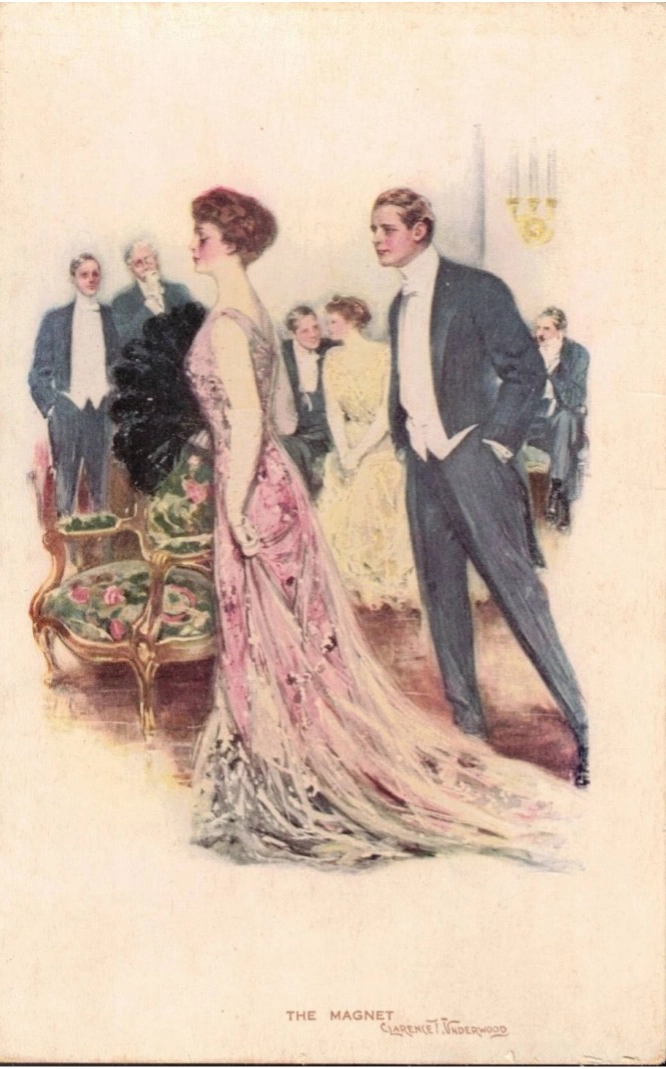
The Magnet, illustration by Clarence F. Underwood; American postcard from 1910, published by R. Chapman Co. and Taylor, Platt & Co., New York, series 782 (Own collection)
The woman on this 1910 postcard is simply called The Magnet. It is not her satisfaction with her body but her effect on men that takes centre stage. Less than a century later, the idea appears in stories about hypnosis and breast enlargement that a woman’s body could be made bigger, more attractive and therefore better. But who actually formulates that desire: the woman herself, the gaze of others, the therapist or the market? And what may a hypnotherapist set against it?
Can hypnosis make breasts grow?
It sounds like a report from the heyday of variety-theatre hypnosis. Yet in 2026 this question became part of a British political row.
Zack Polanski is the leader of the Green Party of England and Wales. Before he went into politics, Polanski worked as a hypnotherapist on Harley Street in London. In 2013 he took part in an article in The Sun. A journalist underwent hypnotherapy with him with the aim of enlarging her breasts. Polanski later stated that his main concern was a more positive body image and that he regretted his involvement.
In March 2026 a BBC radio interview surfaced that had been recorded six days after the newspaper article. In it Polanski spoke about a successful project, more and more anecdotal evidence and the theoretical possibility of breast growth through hypnotherapy. The journalist was said to have measured four inches more. Later Polanski said that he does not believe hypnotherapy can enlarge breasts. The row was therefore not only about breasts, but also about professional credibility and the shelf life of a therapeutic promise.
A nineteenth-century precursor
Anyone who thinks this desire only arose with modern hypnotherapy and cosmetic self-improvement has to go back more than a century and a half.
Antonio Regazzoni (? – 1870) was an Italian magnetiser who gained fame in the middle of the nineteenth century with public demonstrations of animal magnetism. In them he presented not only the classic phenomena of magnetic sleep, catalepsy and numbness, but also claimed to be able to produce very localised bodily changes. In his practical method he used passes, touch and targeted hand movements to influence individual parts of the body. His performances were strongly demonstrative: not only the subject but also the audience had to be able to see that something was changing.
Regazzoni was moreover known for a particularly drastic technique that his admirers called foudroiement. Rather than slowly bringing the subject into magnetic sleep, he tried to overwhelm her, as it were, with one powerful intervention. An enthusiastic contemporary describes how Regazzoni threw his subjects into catalepsy “with the speed of lightning and the violence of thunder”. The image says a great deal about his style: he did not want to show a barely perceptible inner change, but a visible effect that made an immediate impression on the audience.
One of the most remarkable phenomena was the so-called turgescence mammaire: a temporary swelling or distension of the female breast under the influence of magnetic touch. A critical report from 1855 even speaks of a “turgescence de toute la glande mammaire”, that is, a distension of the entire mammary gland. Remarkably, the observer does not deny the change, but rejects Regazzoni’s magnetic explanation and looks for a physiological cause. It is precisely this phenomenon that draws the attention of physicians and other observers.
That breast turgescence attracted so much interest need not be explained solely by scientific curiosity. The magnetic séance usually brought together a male magnetiser and a female somnambulist in a situation in which touch, physical dependence and public observation could go unusually far.
Regazzoni determines where he directs his hands and which part of the body the audience should then observe. That is precisely why his breast experiment acquires several meanings at once. It is medically interesting because people believe they see a directly observable physiological change; theoretically because it raises the question whether will, touch or “magnetic force” can really influence local tissue.
As a public demonstration it moreover has a clear erotic potential: a man who, by touch, makes a woman’s breast visibly swell is hardly a sexually neutral image, even if it is packaged in medical language.
That does not mean that every spectator watches with erotic intentions, nor that Regazzoni presents the phenomenon as erotic. But it is precisely the combination of medical legitimacy, physical intimacy and public display that makes magnetism a terrain on which science, spectacle and sexuality can easily merge.
That such situations could also take on a sexual charge for contemporaries becomes even clearer later with Binet and Féré. In hypnotised women they describe so-called zones érogènes: according to them, touching certain parts of the body can, in deep somnambulism, even evoke genital sensations and an orgasm. They therefore warn that the investigator should never be alone with the subject, precisely because of the accusations and abuses to which such a situation can give rise.
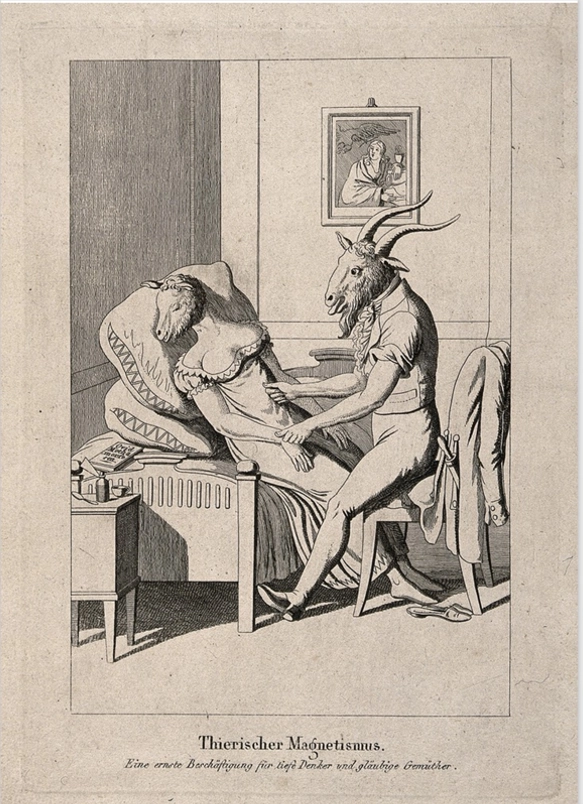
A man with a goat’s head strokes a sleeping woman with a ewe’s head; a depiction of animal magnetism and its use by physicians. Etching after M. Voltz (?), 1815. Licence: Creative Commons Attribution 4.0 International (CC BY 4.0). Source: Wellcome Collection. Next to the woman lies Ovid’s Metamorphoses (‘Transformations’).
Regazzoni is thus a remarkable precursor of the later stories about breast enlargement through hypnosis. With him it is not yet a question of lasting cosmetic growth, but of a temporary, visible bodily change. The idea behind it, however, is already recognisable: a mental or magnetic technique could influence not only the experience of the body, but the body itself.
Hypnosis and breast enlargement: old research, limited evidence
The scientific shelf is not entirely empty. James E. Williams published a study among nineteen volunteers in 1974. A first comparison between hypnosis with and without growth suggestions involved only three women per group; after that, thirteen participants served as their own controls. Williams reported measurable increases.
In 1977 Richard D. Willard had twenty-two women practise self-hypnosis and imagery for twelve weeks and reported some enlargement in all participants.
Allan R. Staib and D. R. Logan followed three women that same year and likewise reported growth, with some loss at follow-up measurement.
These publications are historically interesting, but they are not a solid basis for treatment. The groups were small, blinding was absent and the measurements were sensitive to posture, breathing, measuring site, weight and hormonal fluctuations. A number does not become objective through the tape measure alone. The honest judgement is therefore not that breast growth is impossible, but that a predictable anatomical effect has not been sufficiently demonstrated.
In the experience of hypnotherapists, hypnosis can indeed influence body experience. After a session a client may breathe more freely, stand differently, monitor less and look at their body with less shame. These are meaningful changes. But you may not rename them as growth of body tissue. A more positive body image and a larger cup size are different treatment goals.
A different body for 11.99 dollars
Everything is for sale on eBay. On that market for subliminal self-help, that distinction disappears. A CD promises subliminal breast enlargement as a non-surgical treatment and costs 11.99 dollars. The same seller offers, for the same amount, a CD promising more intelligence and a higher IQ. For penis enlargement two CDs are apparently needed: the set for a bigger penis and better sexual performance costs 21.99 dollars, almost twice as much. Bigger wonders apparently carry a double rate.
Fear of the dark likewise gets a place in this universe of purchasable suggestion. And for devotion there is “Silent subliminal Bible study – God, Lord, Jesus, Scripture, Christian, Christianity”, also for 11.99 dollars.
Hypnotherapists are forewarned about clients who walk into the practice with this wish list.
Such a rich offering is comical, but also telling. Body, intellect, fear and faith are presented as programmable functions. The silent CD is almost a ritual object: precisely because the message is inaudible, it can be presented as deep and effective. Influence becomes attractive because it is withdrawn from conscious conversation.
The label works before the recording
Research on subliminal self-help tapes shows a different mechanism. Greenwald and colleagues swapped the actual content and the labels of tapes for memory and self-esteem. The promised effects did not occur, but many participants believed they experienced improvement in the area that was on the label. Pratkanis and colleagues later found the same pattern. It was not the hidden message but the expectation that had been raised that predicted the improvement people experienced.
For hypnotherapists this is no minor placebo story. The title of a treatment, the explanation about the subconscious mind, the fee and the reputation of the practitioner are already suggestions before the formal suggestion. They can support treatment, but they can also evoke an illusion of specific change. Short-lived subliminal priming effects in laboratories should therefore not serve as evidence for lasting reprogramming of anatomy, intelligence or faith.
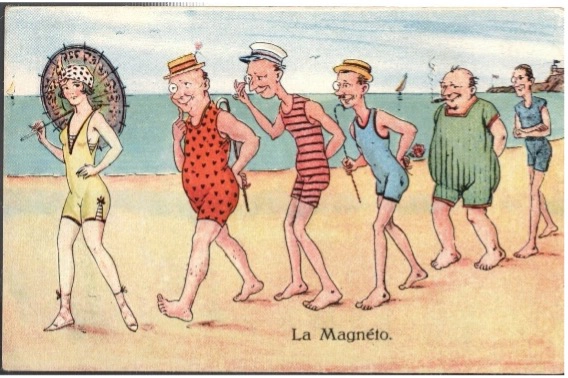
‘La Magnéto’, French postcard, c. 1920–1930: her body draws the attention, while that of her admirers is left out of consideration. (Own collection)
The wish behind the wish
What does a therapist do when a client wants bigger breasts, a bigger penis or a higher IQ? Mockery is tempting, but diagnostically poor. Behind an improbable request for help there may be a recognisable need: wanting to be attractive, reducing shame, experiencing control or finally meeting an imposed norm.
The first step is to slow down: what would change in the client’s life if the goal were achieved? Then the state of the evidence must be explained clearly. The therapist cannot promise anatomical enlargement, but may be able to work on tension, avoidance, self-criticism or body experience. The treatment goal and the way progress is measured must remain explicit.
Are there signs that call for consultation or referral, such as compulsive measuring, constant comparing, severe shame, strong preoccupation or medical questions? A therapist does not need to make a diagnosis outside their own competence to recognise that a suitable medical or psychological assessment may be needed.
The ethics of measure
Professional ethics does not begin with a ban on strange wishes, but with the measure of the answer. Informed consent also means that the client understands what can and cannot reasonably be expected from hypnosis. A disclaimer does not repair a spectacular promise, and “results may vary” does not make an unproven anatomical claim responsible.
Can hypnosis make breasts grow? There are small, old studies that reported enlargement, but there is no convincing modern evidence base for offering this as a predictable treatment result. According to hypnotherapists, hypnosis can influence the experience of the body, the attention paid to it and the behaviour around it. That is valuable enough, as long as it is not disguised as an anatomical guarantee.
The 11.99-dollar CD promises a secret order placed with an almighty inner world. The hypnotherapist can offer something more credible: a careful conversation about desire, expectation, meaning and boundary.
Literature list
- Binet, A. & Féré, C. (1888). Animal Magnetism. London: Kegan Paul, Trench & Co.
- Greenwald, A. G., Spangenberg, E. R., Pratkanis, A. R., & Eskenazi, J. (1991). Double-blind tests of subliminal self-help audiotapes. Psychological Science, 2(2), 119-122. https://doi.org/10.1111/j.1467-9280.1991.tb00112.x
- International Society of Hypnosis. (2018). Code of Ethics. https://www.archive.ishhypnosis.org/administration/code-of-ethics/
- National Research Council. (1991). Subliminal self-help. In In the Mind’s Eye: Enhancing Human Performance. National Academies Press. https://doi.org/10.17226/1580
- Pratkanis, A. R., Eskenazi, J., & Greenwald, A. G. (1994). What you expect is what you believe (but not necessarily what you get). Basic and Applied Social Psychology, 15(3), 251-276. https://doi.org/10.1207/s15324834basp1503_3
- Société de magnétiseurs et de médecins. (1855). “Sur les prétendues somnambules de M. Regazzoni.” Journal du magnétisme, XIV.
- Staib, A. R., & Logan, D. R. (1977). Hypnotic stimulation of breast growth. American Journal of Clinical Hypnosis, 19(4), 201-208. https://doi.org/10.1080/00029157.1977.10403876
- Walker, P. (2026, 11 March). Zack Polanski repeated claim hypnosis can increase breast size, BBC interview reveals. The Guardian.
- Willard, R. D. (1977). Breast enlargement through visual imagery and hypnosis. American Journal of Clinical Hypnosis, 19(4), 195-200. https://doi.org/10.1080/00029157.1977.10403875
- Williams, J. E. (1974). Stimulation of breast growth by hypnosis. The Journal of Sex Research, 10(4), 316-326. https://doi.org/10.1080/00224497409550865

Author
Johan Eland is regarded as one of the leading experts in the field of hypnosis literature in the Netherlands. With a strong background in behavioural sciences and a deep passion for scientific research into hypnosis, he regularly writes blogs in which he shares his knowledge.
He is the author of Het hypnotisch oxytocinisch complex and owns an antiquarian bookshop called Lilith with a large collection of hypnosis books in several languages, including old and special editions. These books are for sale via Boekwinkeltjes. Johan can be reached at info@lilith.nl