

From bell and ghost to Charcot, shell shock, street hypnosis and Dave Elman. The principles behind the scare hypnosis of the past still form the basis of modern street hypnosis today.
 At first glance, this postcard with the caption The Inventors of Hypnotism lookslike a simple joke. Two street boys are getting into mischief. One boy hoists up on a stick a white “ghost” with mask-like face in front of an open window. The other pulls the bell adrift. Inside, a woman scares herself senseless: her eyes are wide open, her mouth falls open and her hands clasp together.
It is precisely the combination of image and sound that makes the card special. The victim is startled not only by a sudden visual effect, but at the same time by noise. The boys create a small sensory robbery.
The image and caption “The Inventors of Hypnotism Work only because around 1900 many people were already familiar with the idea that sudden fright can temporarily disrupt consciousness. It is not only hypnotists and doctors who ponder this idea; newspapers, variety theaters and popular visual culture also play with it. The chart turns that idea into popular entertainment. It suggests that hypnosis is not necessarily produced by mysterious magnetic forces or solemn suggestions, but sometimes simply by scaring the hell out of someone.
The back of the card also helps to place her historically. At the top it says “Postkarte” in 15 languages. On the left we read “Printed in Germany.” Sender is Nellie who sent the card to Jongej. B. van Son, Utrechtschestraat 15 in Amsterdam. The postmark indicates Aug. 8, 1912.
This places the card precisely in the period when hypnosis, nerve shocks, hysteria and suggestion formed broad cultural fascinations. That the card was printed in Germany and in so many languages suggests that the depiction of shock hypnosis was widely recognizable.
Around that time, terms such as Schreck hypnotism, Schreck-Somnambulism, startle hypnosis, startle magnetism and startle paralysis appear in medical and psychological literature. Researchers are trying to understand why sudden stimuli – loud noises, unexpected touches, flashes of light or abrupt commands – sometimes seem to evoke rigidity, automatic obedience or trance-like states
The picture postcard touches on a serious cultural and scientific debate. It is not at the edge of the history of hypnosis, but in the middle of it.
The nineteenth century as a nervous age
Interest in fright hypnosis does not arise by accident. The nineteenth century developed an almost obsessive fascination with nerves, overstimulation and alteration of consciousness. Modern society rapidly produced new experiences: railroads, speed, sensational journalism and, especially in the city, electric lights, mass gatherings, variety shows and theater.
The nervous system seems to be increasingly vulnerable. Doctors speak of neurasthenia, hysteria and nervous exhaustion. At the same time, there is a growing belief that emotions can act directly on the body.
Hypnosis appears precisely in that field of tension. It appears at once modern and archaic: it is a neurological phenomenon and a psychological experiment. In addition, it is a technique of influence and both a form of theater and at the same time a remnant of magic.
Sudden startle reactions especially fascinate researchers. Why do some people stiffen in the face of unexpected tension? Why do others seem to temporarily react automatically? Why can fright sometimes disable ordinary thinking? The nineteenth century sought answers in magnetism, hysteria, suggestion and neurology.
From Mesmer to Faria: from liquid to attention
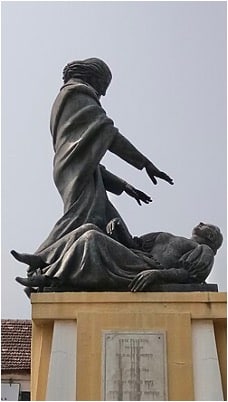
History begins in part with Franz Anton Mesmer. In the late eighteenth century, he develops his theory of animal magnetism. According to Mesmer, a subtle universal force flows through man and nature. Disease occurs when that flow is disrupted. Mesmer uses magnetic passes, iron rods, music and group sessions around the famous baquet. Patients’ reactions are often spectacular: convulsions, crying, rigidity, trance and emotional release. Although Mesmer’s theory is scientifically rejected, one element remains important: strong expectation and emotional tension can evoke deep physical reactions. Abbé José Custódio de Faria then breaks radically with Mesmer’s fluid theory. In De la cause du sommeil lucide of 1819, he argues that hypnosis arises primarily through concentration and suggestion. Yet Faria also uses remarkably abrupt methods. His famous command Dormez! can put subjects into trance almost immediately. To contemporaries, this looks dramatic. Ordinary consciousness seems to suddenly fall away. Faria thus introduces a crucial shift: not a magnetic force causes the trance, but a psychological reaction. Therein lies precisely an early precursor to shock hypnosis.
Charcot and the theatrical neurology of the Salpêtrière
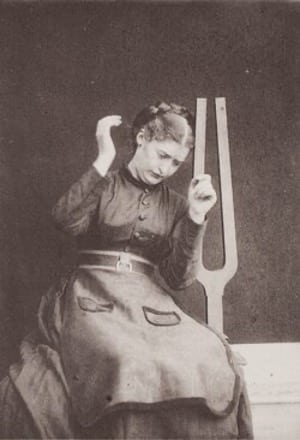
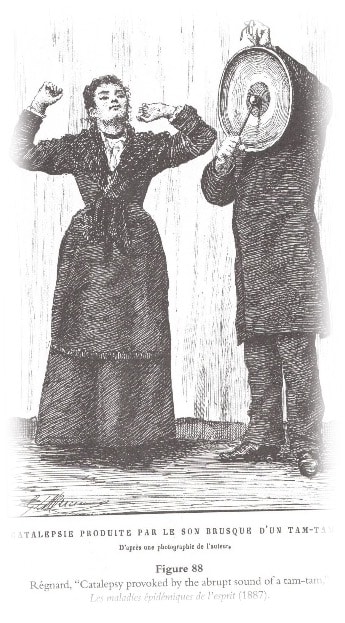
In the second half of the nineteenth century, the subject took on neurological significance with Jean-Martin Charcot at the Paris Salpêtrière. He examines mainly female hysteria patients, the famous grandes hystériques. According to him, they have a special neurological sensitivity that makes hypnotic phenomena visible and reproducible. His famous Tuesday demonstrations attract enormous interest. Doctors, artists, journalists and the curious stream in. The clinic becomes part theater. During those demonstrations, Charcot uses sudden sensory stimuli including gong and tam-tam beats; bright Drummond lime light; vibrating tuning forks and unexpected touches.
Later, Dr. S. Koster writes about how some patients stiffen and cannot move after a hard blow on a tam-tam. He calls these states cataplexy or “shock hypnosis.” According to him such reactions are not on a par with ordinary therapeutic hypnosis.
In other experiments, Charcot puts patients on resonance boxes while heavy tuning forks unexpectedly begin to vibrate. Some patients become cataleptic as a result and remain in imposed postures. Charcot interprets these reactions neurologically. To him, they do not show mysterious power, but a vulnerable nervous system. Yet the demonstrations remain spectacular. Artists draw stiffened bodies. Photographers capture hysterical postures. The line between laboratory and stage constantly blurs.
Nancy versus Paris
Not everyone accepts Charcot’s vision. The Nancy school around Hippolyte Bernheim criticizes his emphasis on hysteria. Bernheim argues that hypnosis is not a rare neurological disorder, but rather a psychological phenomenon of attention and suggestion. According to him, a strong emotional impression can fix attention such that suggestions enter more easily. Thus, the discussion slowly shifts from neurological defects to psychological influence. Fright hypnosis is given a special place in that debate. For Charcot, it proves the neurological vulnerability of hysterical patients. For Bernheim, on the contrary, it shows how sudden attentional fixation makes the mind receptive.
Moll, Dessoir and Schreck-Somnambulismus
Other researchers try to describe the phenomenon more systematically. Albert Moll writes that a sudden startle can produce a state “very close to the hypnotic state.” Max Dessoir later uses the term Schreck-Somnambulism. By this he means states in which a person seems to act automatically after a startle reaction. Ordinary thinking seems to come to a temporary halt in the process. The individual still reacts, but less consciously and more automatically. Modern terms such as dissociation, startle response, freeze response and pattern interrupt
do not yet exist, but the observations come remarkably close.
Scare hypnosis in the newspaper
Interest is not limited to medical journals. Newspapers follow hypnotic experiments with great attention. The Haarlem’s Dagblad of March 31, 1894, reports on hypnotist Dr. Siegfried Wallner’s soirée the previous evening in the Groote Zaal of the theater. He tells visitors to the soirée about various forms of hypnosis, including ordinary hypnosis and shock hypnosis. Hypnosis need not always occur gradually. A sudden stimulus can also immediately evoke a hypnotic state, according to Wallner: “E.g. the noise of a beat on a tam-tam puts one patient into hypnosis.”
Thus Wallner juxtaposes ordinary hypnosis with abrupt shock hypnosis, cataleptic rigidity and hypnotic sleep. Moreover, he refers to the debate between Charcot and the Nancy school, giving the performance a popular-scientific character. Other newspapers also write about magnetic sleep and artificial sleep caused by sudden commands, unexpected touches and about test subjects going into a trance “by a single word.” The press often presents such phenomena half scientific and half sensational. Hypnosis becomes simultaneously serious research and popular entertainment.
Folk beliefs, scare tactics and the evil gaze
However, the cultural roots of fright hypnosis extend further back than modern neurology. In Die Zauberkraft des Auges und das Berufen, Seligmann describes several forms of fright hypnosis associated with the evil gaze. A Jewish housewife in the Bukowina used brooms and melted wax to determine what startled a child. The solidified wax would show the person or animal that caused the fright. Seligmann also mentions Chinese jade seals to protect children from sudden fright. In addition, he describes all kinds of amulets including the schreckstein, which are said to protect against harmful influences of fright and the evil gaze. Here fright is not a neurological phenomenon, but an impairment of life force, soul or protection. Yet the core remains recognizable: sudden emotional shocks can disrupt the body.
Exorcism and ritual terror
Exorcism also shows remarkable parallels to fright hypnosis. With Johann Joseph Gassner (1727-1779) we see authority, dramatic rituals, abrupt commands but also religious tension and emotional overwhelm. That combination can evoke trance-like states. Mesmer later responds in part to Gassner. Where Gassner speaks of demons, Mesmer speaks of magnetic forces. Yet both use a similar psychological backdrop: expectation, suspense, suggestion and terror.
Animal hypnosis, thanatosis and immobilization
Modern hypnosis presumably inherits something from both traditions. Beginning in the late nineteenth century, researchers increasingly compared human startle hypnosis to animal behavior. Berthold Stokvis describes how animals suddenly stiffen when one grabs them unexpectedly or puts them in an unnatural position. In addition to chickens, he mentions rabbits, dogs, frogs and even turtles, crabs and insects. In a chicken, by suddenly pressing the head down, one can evoke a state in which the animal remains motionless. Stokvis and others use the terms, tottering reflex, immobilization reflex and thanatosis. Today, biologists usually speak of tonic immobility: an evolutionary survival response in which the animal holds itself dead. Nineteenth-century researchers sometimes call such responses “animal hypnosis.” That term is too broad biologically, but historically understandable. After all, the similarity to human rigidity is striking.
From thanatosis to war scare
Stokvis then extends that comparison to people. During the occupation years, he sees reactions in people who until then were known as psychologically normal. Some freeze completely at the threat of deportation. This immobilization reminds him of hypnotic catalepsy. World War I makes such observations even more urgent. Soldiers under prolonged artillery fire develop symptoms that later come to be called shell shock: mutism; rigidity; tremors; automatic obedience; apathy; twilight states. Ernst Kretschmer describes how shock and fear effects simultaneously violently excite the psychomotor system and can suddenly paralyze it. Among others, he mentions cramping, muscle paralysis, stupor, movement storms, panic escape and clouding of consciousness. With prolonged threats of war, such reactions can become chronic. Civilians also experience similar states during bombings and air raids. In later literature, the term air-raid shock appears for this purpose. Modern trauma psychology explains such reactions differently than nineteenth-century hypnotists did, but the similarities remain striking. Fright narrows consciousness and automates behavior.
Fright hypnosis in popular culture: The Grand Guignol: theater of fear, hypnosis and suggestion
Countless books and short stories featuring all kinds of scare hypnosis appear. The theater, too, is making its presence felt.
The Théâtre du Grand-Guignol is a small Paris theater famous for horror, insanity, medical experiments and psychological terror from 1897 to 1962. Founded by Oscar Méténier in Pigalle, it grew into the theater of shock around 1900. The Grand Guignol is particularly interesting because of its close association with hypnosis, hysteria and suggestion. The theater emerges at a time when Paris is fascinated by Jean-Martin Charcot’ s demonstrations at the Salpêtrière. There, hysterical seizures, trance, catalepsy and hypnotic states are shown almost as stage sets. The Grand Guignol takes on that medical atmosphere, but turns it into horror.
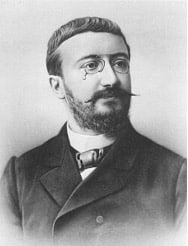
A key figure is André de Lorde(1869-1942), the “prince of fear.” He writes in the early twentieth century many Grand Guignol pieces on madness, psychic compulsion, hereditary degeneration and medical power. Notable is his collaboration with psychologist Alfred Binet(1857-1911), known for the intelligence test, but also for his work with suggestion, double consciousness and hypnosis. Hypnosis in the Grand Guignol is usually not a neat parlor trick, but a fear image: someone loses his will, falls under the influence of a doctor, lover, madman or idea, and does something without still being “himself.” By 1900, the fear of suggestion criminelle – crime under hypnotic influence – is widespread.
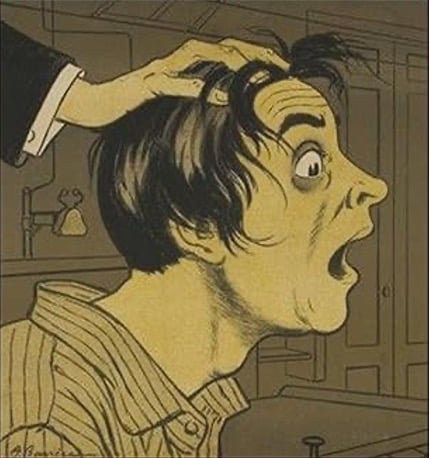
An important example is Le Système du docteur Goudron et du professeur Plume, after Edgar Allan Poe, connected to the Grand Guignol around 1903. Here the insane asylum becomes an upside-down world in which doctor and patient are indistinguishable. In Le Laboratoire des hallucinations by André de Lorde and Henri Bauche, performed in 1916, the laboratory becomes a place where hallucinations, experiments and psychic manipulation coincide.
The Grand Guignol itself worked almost hypnotically. The performances alternated between horror and farce, relaxing and re-engaging the audience each time. The effects are gory, but the strongest effect lies in suggestiveness, tension, silence, light, frightened looks, medical instruments and the sense that the human will is fragile. After World War II, the theater lost its power; reality overtook the theatrical horror and in 1962 it closed its doors for good.
Why does terror work so strongly?
Nineteenth-century researchers offer several explanations for startle hypnosis. Bernheim emphasizes attentional fixation in which the sudden stimulus draws all attention to one point.
Other authors speak of interruption of consciousness, temporary shutdown of critical thinking, automatic obedience and dissociation. Modern psychology uses terms such as: startle response, freeze response, cognitive overload and pattern interrupt. The core, however, remains remarkably constant. That is an unexpected shock that briefly interrupts the normal mental pattern. In that brief moment, suggestions get their chance.
Street hypnosis: the civilized mini-scare
In modern street hypnosis, this mechanism is evident.
Street hypnotists often use a pattern interrupt: an abrupt interruption of automatic behavior. The best-known example is the handshake interrupt.
A person expects an ordinary handshake. In the middle of that automatic movement, the hypnotist suddenly changes the pattern and immediately gives a suggestion: “Sleep.””Look here.” Or “Relax.”
The person usually does not experience intense fear, but does experience a brief cognitive shock:
“What’s going on here?”
That moment of confusion narrows attention.
Street hypnosis thus does not use a brutal scare like Charcot’s tamtam or lime light. It uses a social mini-shock: a controlled surprise.
Other street techniques work similarly: hand drop; hand clasp; shock induction.
In each case, an automatic pattern of expectation is abruptly interrupted.
Touch as a historical thread
Touch plays a notable role throughout the history of shock hypnosis.
With Charcot and other nineteenth-century researchers, an unexpected touch can itself constitute the shock stimulus.
In street hypnosis, touch takes on a strategic function: the handshake; a sudden arm movement; guiding a movement.
Touch helps to break the automatic behavior.
With Dave Elman, that role changes again. There, touch primarily supports relaxation, attention, focus and safety.
With Milton Erickson, touch is mostly unimportant. He shifts the interruption to language and meaning.
Dave Elman: the domestication of the startle response
Dave Elman provides a crucial transition between ancient shock hypnosis and modern hypnotherapy.
He originally worked in entertainment and radio, but later develops rapid hypnosis techniques that doctors in particular appreciate for their efficacy.
He no longer uses brutal sensory shocks. Yet his method remains based on the same fundamental principle: a temporary interruption of expectations.
His well-known induction begins with eye closure and relaxation. The client is then given the suggestion that the eyelids are so relaxed that they cannot open.
When a person then tries to open the eyes and notices that they cannot, a brief moment of cognitive disruption occurs: “Why can’t this work?”
That very moment Elman uses for further deepening.
The old startle reaction here turns into a controlled mental surprise.
Elman’s technique of fractionation also fits the same line. The client repeatedly opens and closes the eyes. Each transition between responding and sinking again constitutes a slight interruption of ordinary consciousness.
As a result, the trance deepens further and further.
Historically, then, Elman “tames” the old startle hypnosis: less theater; less fear; more technique; more control; more therapeutic applicability.
Erickson: terror without terror
Milton Erickson then forms another shift.
Whereas Charcot works with sensory shocks and Elman with rapid cognitive inductions, Erickson uses mainly metaphors, ambiguity and subtle confusion but also indirect suggestions and shifts in meaning.
Erickson also interrupts ordinary patterns of thinking, but much more subtly. The “shock” now takes place in language.
A client expects a logical conversation, but Erickson unexpectedly changes the direction of meaning. This causes ordinary analyzing to pause for a moment, and even then attentional fixation, temporary confusion and increased receptivity occur.
The sensory shock of Charcot’s gong eventually turns into semantic disruption.
From fanfare to language
From a historical perspective, this creates a remarkable development.
In Charcot, the interruption still appears as brutal sensory shock with gong blasts, lime light, tamtams and sudden startle reactions.
In street hypnosis, that shock turns into social confusion via handshake interruptions and rapid pattern breaks.
Dave Elman then makes the same dynamic suitable for therapeutic use through controlled cognitive inductions and fractionation.
Milton Erickson largely shifts the mechanism to language, metaphors and subtle mental dysregulation.
The techniques change dramatically, but the core remains remarkably constant: ordinary consciousness is briefly interrupted, after which suggestion more readily takes hold.
The picture postcard revisited
From that long history, the postcard The Inventors of Hypnotism takes on surprising significance.
The two boys seem like simple pranksters, but they are actually performing a miniature version of a much larger cultural idea: sudden fright can disrupt consciousness.
Their method contains almost all the classic ingredients: unexpected stimulus, sensory assault, attention fixation, emotional shock and temporary disruption.
The card thus parodies not only hypnosis, but also the then modern obsession with nerves, suggestion and suggestibility.
What happens in the Salpêtrière with tamtams and lime light, happens here with a sheet and a bell.
Conclusion
Fright hypnosis is a forgotten but fascinating chapter in the history of hypnosis and suggestion.
From popular belief in fright disease and the evil gaze, through Mesmer, Faria and Charcot, to shell shock, street hypnosis, Dave Elman and Erickson runs a remarkably consistent line:
sudden fright or disruption can temporarily interrupt ordinary consciousness.
Nineteenth-century physicians described that mechanism with terms such as: Schreckhypnotismus; Schreck-Somnambulismus; cataplexy; startle paralysis.
Modern hypnotists are more likely to speak of pattern interrupt, attention fixation and cognitive confusion.
But the underlying phenomenon remains recognizable.
As a result, Charcot’s old drumbeat still resonates: in war trauma, in street hypnosis, in rapid inductions, and even in the humor of a 1908 Amsterdam postcard.
Literature List
- Bernheim, H. – Hypnotism, Suggestion, Psychotherapy. Akademic readings , 1891
– Binet, A. & Ch. Féré – Le magnétisme animal, 1887 - Charcot: Didi-Huberman, Georges, Invention of Hysteria: Charcot and the Photographic Iconography of the Salpêtrière, 2003
– Dessoir, M. – Das Doppel-Ich, 1896
– Elman, D. – Hypnotherapy, 1983
– Erickson, M.H. & E.L. Rossi – Hypnotherapy. An Exploratory Case Book , 1979
– Faria, L’Abbé de – De la sommeil lucide ou Étude de la Nature de l’Homme, 1906
– Gassner – Die wirksame Psychotherapie des Teufelsbanners Johann Joseph Gassner 1775 (B. Peter), in: Hypnose und Kognition, Band 17, 2000
– Koster, S. – Textbook of hypnosis. Including hypno-analysis. , 3rd edition, 1956
– Kretschmer, E. – Psycho-therapeutische Studien, 1949
– Menge, A. – Schreckenvisionen: Destruktionsängste in E.T.A. Hoffmann’s “Der Sandmann”, 2007 (GRIN)
– Moll, A. – Der Hypnotismus, 1907 - Seligmann, S. Die Zauberkraft des Auges und das Berufen, z.j /1921 ,
– Stokvis, B. – Hypnosis in the practice of medicine, 1953
– Panse, F. – Angst und Schreck, 1952
– Voss, G. – Der Hypnotismus, 1907(Schreckhypnosis, p. 22)
– Vroom, M.G. – Fright, anxiety and fear, 1946

Author
Johan Eland is considered one of the leading experts on hypnosis literature in the Netherlands. With a strong background in behavioral sciences and a deep passion for scientific research on hypnosis, he regularly writes blogs sharing his knowledge.
He is author of The Hypnotic Oxytocinic Complex and owns an antiquarian bookstore called Llith with a large collection of hypnosis books in various languages, including old and unusual editions. These books are for sale through Bookstores. Johan can be reached at info@lilith.nl